Why Your Hair Gets Greasy So Fast (And What It Means)
- Apr 15
- 3 min read
Greasy hair can feel frustrating.
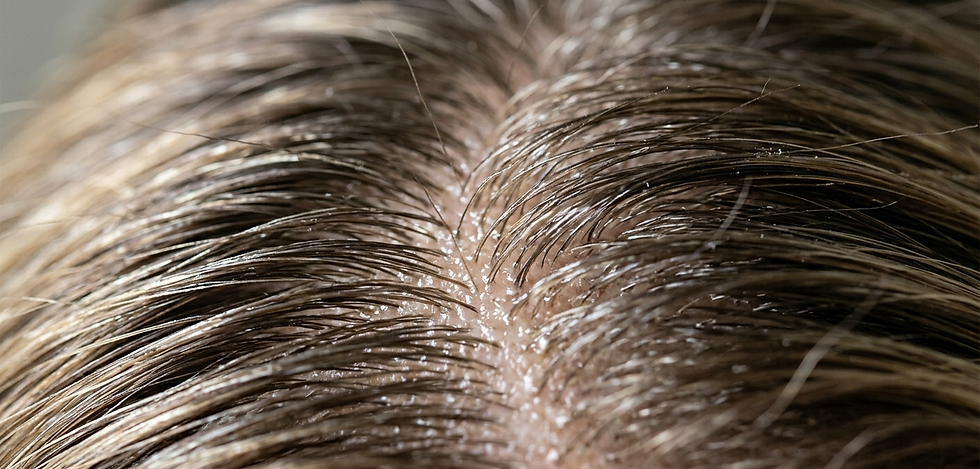
You wash it… and within a day, sometimes even hours, your roots already feel oily again.
It often leads to overwashing, switching products, and trying quick fixes. But in many cases, greasy hair is not the problem itself.
It’s a signal.
In Ayurveda, excess oil is a sign that the scalp is out of balance, and understanding why it happens is the first step to fixing it.
What Causes Hair to Get Greasy So Quickly?
Your scalp naturally produces oil (sebum) to protect and hydrate the hair. This is a normal and necessary function.
However, when this system becomes unbalanced, oil production can increase.
Common causes include:
overwashing
product buildup
hormonal changes
stress
scalp imbalance
Scientific research shows that sebaceous gland activity directly influences scalp oil levels and hair condition.👉 https://www.ncbi.nlm.nih.gov/books/NBK459248/

The Overwashing Cycle
One of the most common hidden causes of greasy hair is washing too often.
When you wash your hair frequently:
natural oils are stripped
the scalp feels “dry”
the body compensates by producing more oil
This creates a cycle:
wash → dry → overproduce oil → wash again
According to dermatology guidance, washing frequency should match your scalp type rather than follow a fixed daily routine.👉 Read more
What Ayurveda Says (Kapha Imbalance)
In Ayurveda, greasy hair is often linked to Kapha imbalance.
Kapha is associated with:
heaviness
moisture
oiliness
When Kapha increases, the scalp may:
produce excess oil
feel heavy
develop buildup
This doesn’t mean you need harsher cleansing.It means you need balance.
Signs Your Greasy Hair Is Actually an Imbalance
If your hair gets greasy quickly, you may also notice:
flat or lifeless hair
scalp buildup
occasional itching
difficulty maintaining volume
👉 You may also relate to this in Signs Your Scalp Is Out of Balance
What Actually Helps (Not What You Think)
Most people respond to greasy hair by:
❌ washing more❌ using stronger shampoos❌ avoiding oils completely
But Ayurveda takes a different approach.
1. Balance Before Removing Oil
Instead of removing oil aggressively, Ayurveda focuses on regulating it.
This means:
gentle cleansing
avoiding harsh stripping
restoring scalp balance
2. Use Oil (Yes — Even If Your Hair Is Oily)
This may sound surprising.
But using the right oil, in the right way, can actually help regulate oil production.
Why?
Because when the scalp receives balanced nourishment, it doesn’t need to overproduce oil.
Certain natural oils also help maintain scalp microbiome balance.
Research suggests plant-based oils can influence microbial balance and scalp condition.
3. Keep Your Routine Simple
Too many products can trap oil and create buildup.
Instead:
✔ use fewer products✔ focus on scalp care✔ stay consistent
👉 Learn more in Ayurvedic Hair Care Mistakes to Avoid

Where Amla Comes In
This is where things become interesting.
Amla is one of the most important herbs in Ayurvedic hair care, especially for balancing scalp conditions.
It is traditionally used to:
support scalp health
strengthen roots
maintain natural oil balance
Instead of stripping oil, Amla works by supporting the scalp environment.
This makes it especially useful for:
✔ oily scalp✔ unbalanced oil production✔ dull, heavy hair
When used regularly, either in masks or oil-based treatments, it helps bring the scalp back to a more stable state.
👉 You can also explore how natural ingredients work differently in Ayurvedic Ingredients vs Conventional Hair Products

The Shift You Need to Make
Instead of asking:
“How do I remove oil faster?”
Try asking:
“How do I help my scalp stay balanced?”
This shift changes everything.
Final Thought
Greasy hair is not something to fight. It’s something to understand.
In Ayurveda, every symptom is a message, and when you respond correctly, the body naturally finds balance again.
At Melina, we focus on simple, consistent care that supports the scalp rather than working against it.

Comments